Samsung makes fast expensive storage but even cheap storage can max out SATA, hence there's no point Samsung trying to compete in the dwindling SATA space.
replies(1):
Going forward, SAS should just replace SATA where NVMe PCIe is for some reason a problem (eg price), even on the consumer side, as it would still support existing legacy SATA devices.
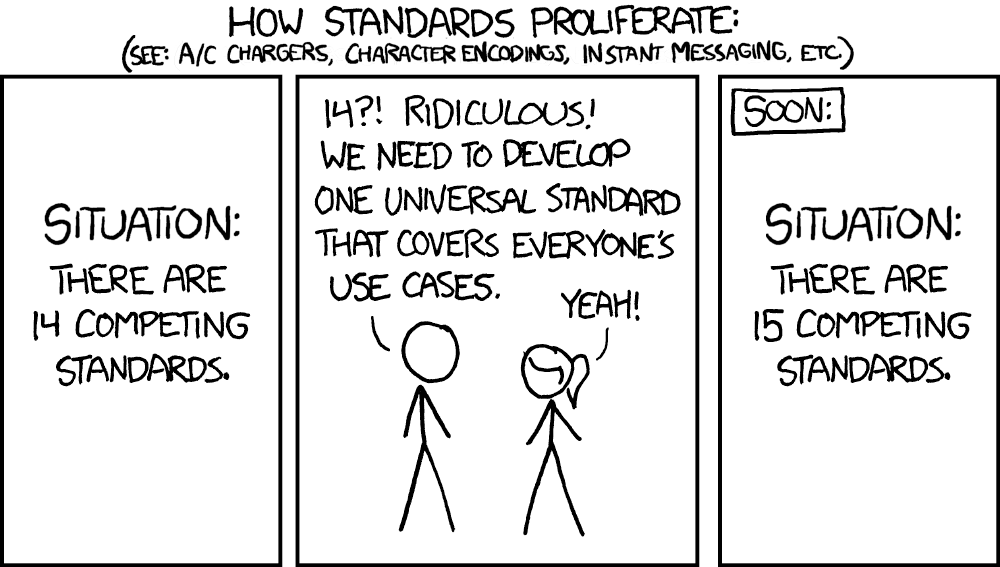
Storage related interfaces (I'm aware there's some overlap here, but point is, there's already plenty of options, and lots of nuances to deal with already, let's not add to it without good reason):
- NVMe PCIe
- M.2 and all of it's keys/lengths/clearances
- U.2 (SFF-8639) and U.3 (SFF-TA-1001)
- EDSFF (which is a very large family of things)
- FibreChannel
- SAS and all of it's permutations
- Oculink
- MCIO
- Let's not forget USB4/Thunderbolt supporting Tunnelling of PCIe
Obligatory: https://imgs.xkcd.com/comics/standards_2x.png
The main problem is having proper translation of device management features, e.g. SMART diagnostics or similar getting back to the host. But from a performance perspective, it seems reasonable to switch to USB once you are multiplexing drives over the same, limited IO channels from the CPU to expand capacity rather than bandwidth.
Once you get out of this smallest consumer expansion scenario, I think NAS takes over as the most sensible architecture for small office/home office settings.
Other SAN variants really only make sense in datacenter architectures where you are trying to optimize for very well-defined server/storage traffic patterns.
Is there any drawback to going towards USB for multiplexed storage inside a desktop PC or NAS chassis too? It feels like the days of RAID cards are over, given the desire for host-managed, software-defined storage abstractions.
Does SAS still have some benefit here?
USB4 is just passing PCIE traffic and should be fine, but at that point you are paying >$150 per usb4 hub (because mobos have two at most) and >$50 per m.2 converter.