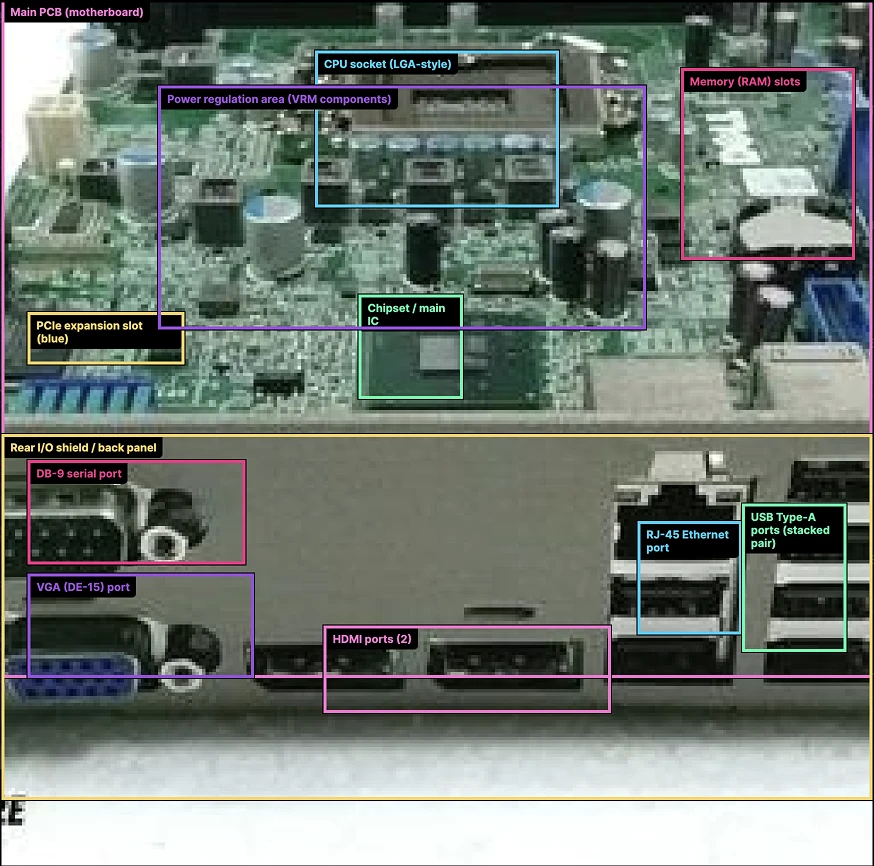
It just overlaid a typical ATX pattern across the motherboard-like parts of the image, even if that's not really what the image is showing. I don't think it's worthwhile to consider this a 'local recognition failure', as if it just happened to mistake CMOS for RAM slots.
Imagine it as a markdown response:
# Why this is an ATX layout motherboard (Honest assessment, straight to the point, *NO* hallucinations)
1. *RAM* as you can clearly see, the RAM slots are to the right of the CPU, so it's obviously ATX
2. *PCIE* the clearly visible PCIE slots are right there at the bottom of the image, so this definitely cannot be anything except an ATX motherboard
3. ... etc more stuff that is supported only by force of preconception
--
It's just meta signaling gone off the rails. Something in their post-training pipeline is obviously vulnerable given how absolutely saturated with it their model outputs are.
Troubling that the behavior generalizes to image labeling, but not particularly surprising. This has been a visible problem at least since o1, and the lack of change tells me they do not have a real solution.